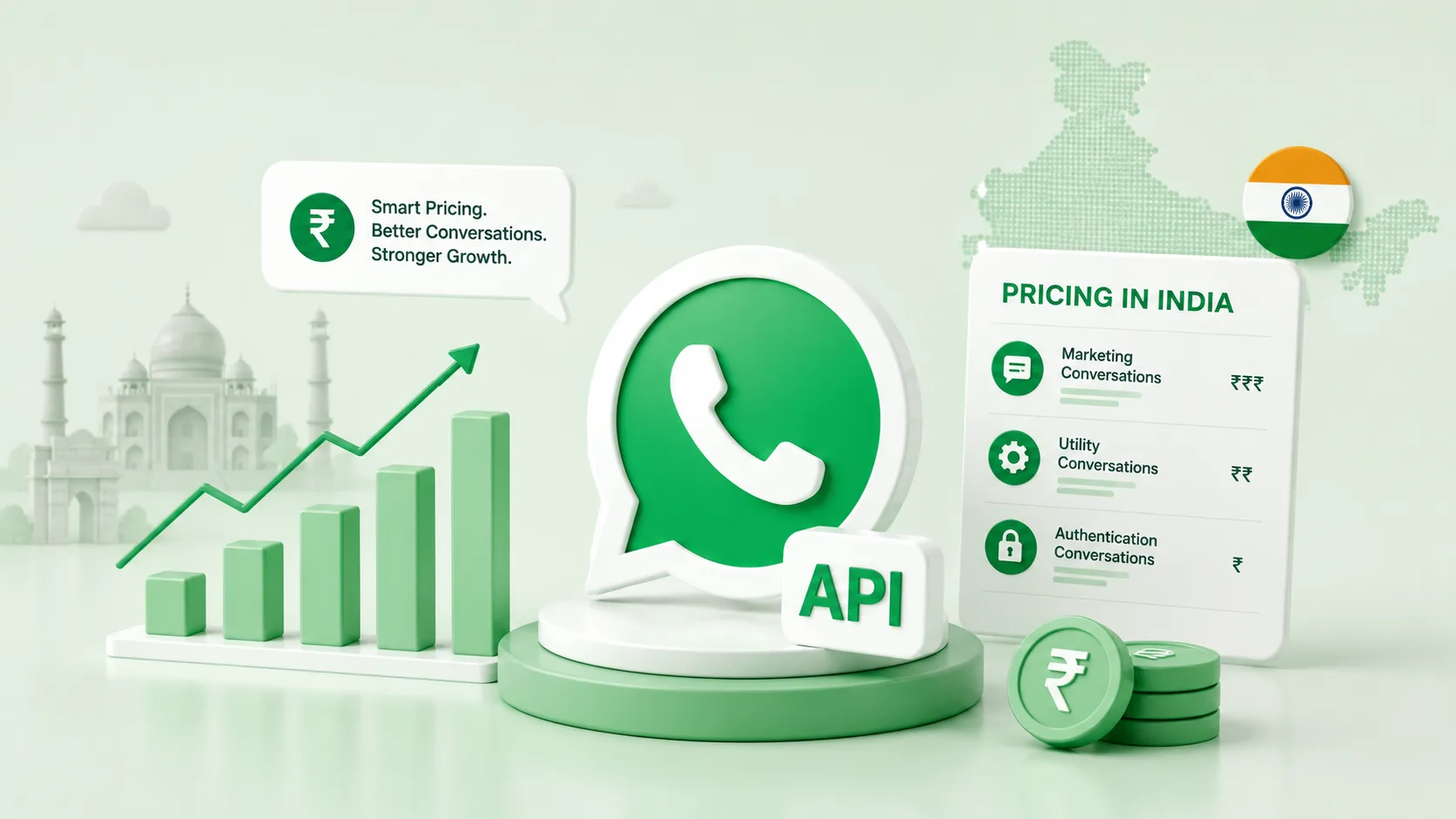
What Is WhatsApp Business API Pricing?
WhatsApp Business API pricing is the cost businesses pay to send and receive messages through the WhatsApp Business Platform. Unlike the free WhatsApp Business App, API pricing is designed for companies that need team collaboration, automation, CRM integration, chatbots, and large-scale customer communication.
The total cost typically includes Meta conversation or message charges, platform fees from your Business Solution Provider (BSP), and any additional costs for automation, CRM integrations, or support workflows.
For most businesses, the challenge is not understanding the published pricing table. The real challenge is estimating monthly costs accurately based on message volume, campaign frequency, customer support conversations, and automation usage.
How WhatsApp Pricing Works
Meta uses a conversation-based and message-category pricing model. Depending on your region and the type of message being sent, different rates may apply.
When evaluating WhatsApp Business API pricing, it helps to separate costs into three layers:
| Cost Component | What It Covers | Typical Impact |
|---|---|---|
| Meta Charges | Message delivery and conversation costs | Variable |
| BSP Platform Fees | Inbox, CRM, automation and management tools | Fixed or usage based |
| Internal Operations | Agents, workflows and support resources | Depends on team size |
Businesses often focus only on Meta charges and overlook platform costs, agent productivity, and automation opportunities. A lower messaging rate does not always result in a lower overall operating cost.
WhatsApp Message Categories
Message categories help determine how conversations are billed and how businesses can engage customers. Understanding these categories is essential when estimating WhatsApp API costs.
| Category | Common Use Cases | Examples |
|---|---|---|
| Marketing | Promotional campaigns and offers | Discount announcements, product launches |
| Utility | Transactional notifications | Order updates, payment confirmations |
| Authentication | Identity verification | OTP and login verification messages |
| Service | Customer support interactions | Support and issue resolution |
WhatsApp Business API Pricing in India
Businesses evaluating WhatsApp Business API pricing in India often discover that there is no single monthly fee. Costs depend on message categories, customer engagement volume, the platform provider you choose, and the level of automation required.
For example, an ecommerce brand sending order updates, abandoned cart reminders, and promotional campaigns will have a different cost structure than a SaaS company using WhatsApp primarily for lead qualification and customer support.
The most accurate way to estimate costs is to calculate expected monthly message volume, identify message categories, and then factor in platform fees, automation requirements, and team usage.
Example Cost Scenarios
The following examples illustrate how messaging volume can influence your overall WhatsApp budget. Actual charges vary by country, message category, and provider pricing.
| Business Type | Monthly Messages | Primary Use Case | Relative Cost |
|---|---|---|---|
| Local Retail Store | 5,000 | Promotions and support | Low |
| Growing Ecommerce Brand | 25,000 | Order updates and campaigns | Medium |
| Large Online Business | 100,000+ | Marketing, support and automation | High |
Rather than focusing exclusively on message costs, successful teams evaluate cost per qualified lead, cost per order, and support efficiency improvements generated through WhatsApp.
How BSP Charges Affect Pricing
Meta provides the underlying messaging infrastructure, but most businesses access the WhatsApp Business Platform through a Business Solution Provider (BSP). BSPs typically offer additional features such as shared team inboxes, CRM integrations, automation workflows, analytics, and chatbot builders.
| Feature | Basic Access | Business Platform |
|---|---|---|
| Shared Team Inbox | Limited | Included |
| Workflow Automation | Manual | Advanced |
| CRM Integration | Custom Development | Usually Included |
| Reporting and Analytics | Basic | Comprehensive |
When comparing providers, avoid evaluating pricing alone. Consider automation capabilities, CRM connectivity, team productivity features, onboarding support, and scalability requirements.
Ready to scale your business with WhatsApp?
Get started with AxoDesk's shared team inbox and automated lead routing today.
Budget Planning Framework for WhatsApp API
One of the most common mistakes businesses make is estimating WhatsApp costs based solely on current messaging volume. As adoption grows, conversation volume, campaign frequency, support interactions, and automation usage often increase significantly.
A more reliable approach is to build a budget using expected business outcomes rather than message counts alone. This helps ensure your WhatsApp channel remains cost-effective as your customer base expands.
| Planning Factor | Questions to Ask | Why It Matters |
|---|---|---|
| Marketing Campaigns | How many promotional broadcasts will be sent monthly? | Directly impacts marketing message volume. |
| Customer Support | How many support conversations occur each month? | Determines service-related messaging costs. |
| Order Notifications | How many transactional updates are sent? | Affects utility message volume. |
| Authentication Flows | Will customers receive OTPs or verification messages? | Impacts authentication message costs. |
Businesses with seasonal demand should also budget for peak periods such as festive sales, product launches, holiday promotions, and major marketing campaigns.
Hidden Costs Businesses Often Miss
While messaging charges are easy to estimate, several indirect costs can influence the total cost of ownership of a WhatsApp communication system.
- Automation setup: Building chatbots, workflows, and lead routing processes.
- CRM integration: Connecting WhatsApp conversations with sales and customer records.
- Team onboarding: Training agents to handle conversations efficiently.
- Template management: Creating, testing, and optimizing approved message templates.
- Operational monitoring: Tracking delivery rates, response times, and campaign performance.
How to Reduce WhatsApp Business API Costs
Reducing WhatsApp costs does not necessarily mean sending fewer messages. The goal is to improve efficiency while maintaining customer engagement and business outcomes.
- Use automation for repetitive support questions.
- Segment audiences before sending marketing campaigns.
- Remove inactive contacts from promotional broadcasts.
- Track campaign performance and eliminate low-performing templates.
- Integrate WhatsApp with your CRM to improve follow-up efficiency.
- Use shared team inboxes to reduce duplicate agent effort.
Many businesses find that investing in workflow automation and customer segmentation produces larger cost reductions than focusing exclusively on messaging rates.
When WhatsApp Business API Is Worth the Investment
The WhatsApp Business API is most valuable when customer communication directly influences revenue, retention, or operational efficiency. Businesses that handle large volumes of inquiries, sales conversations, bookings, support requests, or order updates often see the greatest benefit.
| Business Type | Common Use Cases | Potential Benefits |
|---|---|---|
| Ecommerce | Order updates, abandoned cart recovery | Higher customer engagement |
| SaaS | Lead qualification and onboarding | Faster sales cycles |
| Healthcare | Appointment reminders | Reduced no-show rates |
| Education | Admissions and student support | Improved response times |
Common WhatsApp API Pricing Mistakes
Many businesses overestimate or underestimate WhatsApp costs because they focus on a single pricing component instead of the complete communication workflow. Understanding common mistakes can help you avoid budget surprises and improve ROI.
- Ignoring platform fees: Looking only at Meta messaging charges without considering BSP or software costs.
- Broadcasting to everyone: Sending promotional campaigns to unsegmented audiences often reduces engagement and increases costs.
- Overlooking automation opportunities: Manual processes can increase operational costs more than messaging expenses.
- Poor template optimization: Low-performing message templates can waste budget and reduce customer engagement.
- No performance tracking: Without reporting, teams struggle to understand the true return on messaging spend.
Choosing the Right WhatsApp Business Platform
Pricing is important, but it should not be the only factor when selecting a WhatsApp platform. The right solution should help your team manage conversations efficiently, automate repetitive tasks, and integrate with existing business systems.
| Evaluation Criteria | Basic Provider | Modern WhatsApp Platform |
|---|---|---|
| Shared Team Inbox | Limited | Advanced Collaboration |
| Automation Workflows | Minimal | Visual Workflow Builder |
| CRM Integration | Custom Setup | Native Integrations |
| Analytics | Basic Reporting | Conversation and Revenue Insights |
| Scalability | Suitable for Small Teams | Supports Growth and Automation |
If your team plans to use WhatsApp for sales, support, marketing, and customer engagement, evaluating the broader platform capabilities can be more important than comparing message rates alone.
Platforms such as WhatsApp CRM, WhatsApp Automation, and WhatsApp Team Inbox can help businesses centralize communication while improving team productivity.
How to Estimate Your Monthly WhatsApp Budget
Use the following framework when planning a monthly WhatsApp budget.
- Estimate monthly customer conversations.
- Identify expected marketing, utility, authentication, and support messages.
- Calculate platform subscription or BSP fees.
- Include automation and integration requirements.
- Plan for seasonal campaigns and peak demand periods.
- Review costs quarterly as messaging volume grows.
Businesses that regularly review messaging performance, customer engagement metrics, and operational efficiency are typically better positioned to optimize WhatsApp costs over time.
Ready to scale your business with WhatsApp?
Get started with AxoDesk's shared team inbox and automated lead routing today.
Frequently Asked Questions
The following questions are among the most common topics businesses research when evaluating WhatsApp Business API pricing.
How much does WhatsApp Business API cost?
The cost of WhatsApp Business API depends on message category, recipient country, messaging volume, and the platform provider you choose. Most businesses pay a combination of Meta messaging charges and platform subscription fees.
Is WhatsApp Business API free?
No. While access to the platform itself may not require a setup fee, businesses typically pay for message delivery and any additional software used for inbox management, automation, analytics, or CRM integration.
What affects WhatsApp Business API pricing?
Pricing is influenced by message category, destination country, conversation volume, automation requirements, support workflows, and the provider used to access the WhatsApp Business Platform.
Do I need a Business Solution Provider to use WhatsApp API?
Most businesses choose a Business Solution Provider because it simplifies onboarding and provides additional features such as WhatsApp Team Inbox, analytics, automation, and CRM integrations.
What is the difference between WhatsApp Business App and WhatsApp Business API?
The WhatsApp Business App is designed for small businesses with basic messaging needs. The API is intended for growing businesses that require multi-agent access, automation, integrations, and large-scale customer communication.
How can I estimate my monthly WhatsApp costs?
Estimate your expected message volume, identify message categories, include platform fees, and account for automation or CRM requirements. Businesses with seasonal campaigns should also budget for traffic spikes.
Can WhatsApp Business API be used for marketing?
Yes. Businesses can send approved marketing templates to customers who have provided the necessary consent. Audience segmentation and message relevance are important for maintaining strong engagement rates.
How can businesses reduce WhatsApp API costs?
Businesses can reduce costs by using WhatsApp Automation, improving audience segmentation, removing inactive contacts, optimizing message templates, and tracking campaign performance.
Final Thoughts on WhatsApp Business API Pricing
WhatsApp Business API pricing is not simply a messaging expense. It is an investment in customer communication, sales efficiency, support operations, and automation. While message charges are an important consideration, businesses should evaluate the total value generated through faster responses, higher engagement, improved conversions, and streamlined workflows.
The most cost-effective WhatsApp strategy is rarely the one with the lowest per-message price. Instead, successful teams focus on optimizing customer journeys, automating repetitive interactions, and using data to improve communication performance over time.
Whether you're launching WhatsApp for customer support, lead generation, sales conversations, or marketing campaigns, understanding pricing fundamentals helps you build a realistic budget and avoid unexpected costs as your messaging volume grows.
If you're evaluating WhatsApp for your business, consider how features such as automation workflows, shared team inboxes, customer relationship management, and broadcast messaging can help maximize the return on your WhatsApp investment.
Founder of Axora Infotech at AxoDesk
Writes about conversational commerce, AI automation, and customer communication strategy.